LifeCare's Transfer of Patients from Chalmette
Five Days at MemorialLifeCare's Transfer of Patients from Chalmette was an early evacuation decision made as Hurricane Katrina threatened southeast Louisiana. It moved medically fragile patients from LifeCare's single-story facility in Chalmette to a leased unit at Memorial Medical Center, where the transfer's urgency met the limits of a scarce ambulance supply—and where one patient died before arrival.
Forecast and Decision
On Saturday, August 27, 2005, Gina Isbell, LifeCare's nursing director in Chalmette, received a warning from her boss: Katrina had strengthened overnight and could strike southeast Louisiana as a major hurricane. Forecasts pointed to landfall on Monday, with hurricane conditions possible by Sunday night. For patients in a low-lying, single-story building, the choice was stark: moving very ill people carried risks, but waiting for a firmer forecast could leave too little time to act or find ambulances.
The threat was sharpened by local memory. St. Bernard Parish had been rebuilt after the 1927 floods, and residents remembered the devastating flooding and pumping-system failure that followed Hurricane Betsy in 1965. Trust in levees and officials was limited. Against that background, LifeCare's leaders chose not to wait for certainty: most patients would go to the organization's unit at Memorial Medical Center, with the few remaining patients sent to another nearby hospital.
Destination and Preparation
The destination was a specialized LifeCare unit within Memorial Medical Center, a hospital-within-a-hospital on an upper floor. LifeCare provided long-term treatment to very ill, often elderly and debilitated patients; many depended on mechanical ventilators while undergoing rehabilitation intended to help them breathe independently and return home or to a nursing facility. It was not a hospice. The unit had its own administrators, nurses, pharmacists, and supply chain, although staff continued to call it LifeCare Baptist, a name that persisted after Tenet Healthcare Corporation bought Baptist Hospital and renamed it Memorial.
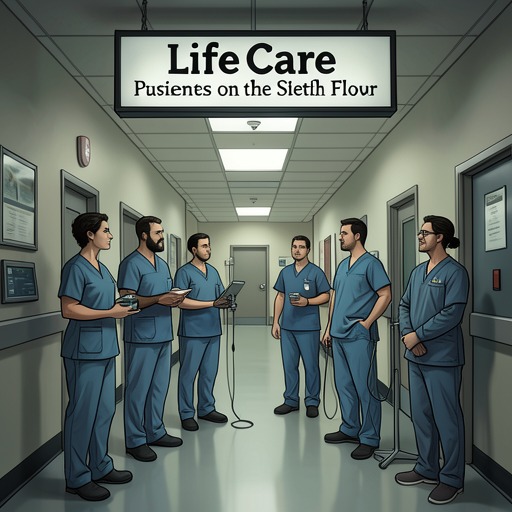
Isbell had already designated an “A” team of nurses to work through the storm, with a “B” team scheduled to replace them afterward. The nurses she called were volunteers she regarded as strong and collaborative, though they would be working in an unfamiliar hospital. Their assignment made the transfer more than a relocation of patients: it also required a prepared group of caregivers to accompany them into the threatened hospital.
The Transfer
It took until nightfall to move nineteen patients to the Memorial campus. The twentieth died on the journey. Ambulances were already in short supply, so patients traveled in groups of as many as four rather than receiving one vehicle each. Their own medications traveled with them, prepared by LifeCare's pharmacist for the move.
The logistics had to accommodate individual bodies and equipment, not an abstract patient count. Emmett Everett, a paraplegic patient who weighed 380 pounds, traveled on his own “Big Boy” bed and was resettled on that same bed at the destination. His transfer makes visible the practical demands hidden inside the decision to evacuate: patients could not simply be moved quickly without regard to the beds, medicines, and support their care required.
Significance
The transfer was a precaution taken before the storm's effects made the danger immediate. Its outcome was already mixed: nineteen patients reached the higher-floor LifeCare unit, but one died en route. The move also concentrated vulnerable patients and their caregivers inside Memorial Medical Center, where they would face the coming crisis together. The early decision therefore preserved time for evacuation while beginning a new set of risks at the receiving hospital.